

People
Employee Retention: Why Good Employees Leave (and How to Prevent It)
Losing a long-tenured employee costs 6–9 months of their salary — and most of the reasons behind it are preventable. Here are the nine most common reasons good people leave, and what to do about each one.
Losing your best, and longest-standing employees can often come as a blindside. Day-in and day-out everything seems to be running smoothly, and then suddenly Dave, your project manager of 12 years, asks to talk to you privately in your office. Your stomach drops as you await those dreaded words: "I'd like to quit." Any variation of those words from employees always leads you into a spiral: why do they want to leave, how will you manage without them, and much more.
"According to a study by the Society for Human Resource Management (SHRM), when an employee leaves it costs an average of 6-9 months of your former employee's salary to find and onboard their replacement" ("14 Reasons"). Not only will it be costly and time-consuming to hire someone, you also may have lost your buddy that you would always discuss how your football team played the night before, the guy who made an effort to say good morning to everyone every day and occasionally brought donuts. Your team culture will feel the loss too. Unfortunately, most of their possible reasons could have been prevented, and could have saved you money, time, and the relationship itself with the right strategies. Below are the top, most common reasons good employees leave, and tips on how to stop history from repeating itself with another high-performing employee you value.
1. Under compensation
One of the main reasons employers hear for employees leaving is that they could be paid more somewhere else. Money is one of the strongest motivators to exit a company for a better quality of life and feeling like their value is compensated fairly.
How to prevent it:
Plan ahead for managing compensation and make incremental improvements often to budget well (rather than large raises that come as a surprise) to show you value loyalty and experience on the job. Make sure salary matches the level of responsibility, the relative city's cost of living, and try to keep it at or above the market rate. Check market rates, cost of living, and assess their workload often to avoid questioning. If budget is limited, offer generous PTO, flexible scheduling, and wellness programs to offset pay expectations ("14 Reasons") ("Why") ("15 Reasons") (Jay).
2. Underappreciation
Not only should you communicate someone's value in their pay, but in recognizing good work. This will motivate them to continue to do well to earn that praise and recognition, acting to sustain business growth as well. "Mary Kay Ash, founder of the Mary Kay cosmetics empire, put it best when she said: 'There are two things people want more than sex and money: Recognition & Praise'" ("14 Reasons").
How to prevent it:
Take time to recognize people. Make it specific to show it's genuine and to motivate the same results in the future. Include bonuses, rewards, informal feedback, public shoutouts, and balance both monetary appreciation with words of affirmation.
3. Escaping a Toxic Workplace
Sometimes, it's not the company itself that is to blame. A crappy manager or coworker that isn't held accountable for their behavior can lead to resentment and create a negative and less productive work environment overall. Even if they are your top sales rep, they are still bringing you a net loss in how they affect the people around them. “In a report from Harvard Business School, Michael Housman and Dylan Minor broke down the real cost of assholes or toxic employees:
‘In comparing the two costs, even if a firm could replace an average worker with one who performs in the top 1%; it would still be better off by replacing a toxic worker with an average worker by more than two-to-one.’” (“14 Reasons”)
How to prevent it:
Fire or turn bad employees around to maintain a positive and productive work environment. Invest heavily in making sure managers are trained in not only leading projects but how to coach others well and that they promote positivity. "More than half of workers (53 percent) say their boss influenced their decision to quit a job, and another 22 percent admit a bad boss has made them seriously consider leaving." (business) Sending automated "Pulse check surveys" can gauge how people are feeling. Heartcount offers surveys that give weekly insights and risk scores that can prevent exits before it's too late. Surveys like these can serve to prevent not only work environment issues but other reasons as well. Heartcount also suggests: "Build anonymous reporting channels and act on feedback quickly... Train managers to create inclusive, nonjudgmental meeting spaces... (and) Reward learning from failure as a cultural norm" ("Reasons"). For leaders and managers, "The quality of your culture starts with you" ("14 Reasons").
4. Need for Autonomy & Trust
Everyone hates micromanagers, especially when they've been there long enough to earn respect. Long-standing employees also expect more trust in the inner workings and decisions of the company, and rightfully so. "ADP's Employee Motivation and Commitment (EMC) Index, based on three years of surveys of 2,500 U.S. workers, found that employees who trusted their teams were 16 times more likely to be motivated and committed. That number jumped to 26 times for those who trusted their managers and 41 times for those who trusted senior leaders" ("Why"). When people aren't being treated like adults and they don't feel they are trusted with company information or in completing their own tasks, that feeling of disrespect may push them out the door. Team members also offer valuable insights and ideas in problem-solving, as they often experience those problems first-hand. Not listening to their ideas will build resentment, and less collaboration will cause less efficiency in decision-making and problem-solving. Obtaining feedback is better for leaders to make their employees feel heard, and pride aside, their ideas may actually be helpful.
How to prevent it:
Foster a culture of open communication without judgement. "When employees see that speaking up leads to real change, they're more likely to keep sharing honest feedback" (Jay). So, ask for feedback and ideas, act when you can, or explain why it's not possible right now. Be a good listener. In terms of their own duties, hold your team accountable for results and trust them in the future with those tasks if proven trustworthy. "Use OKRs (Objectives & Key Results) to clarify priorities without hand-holding" ("Reasons"). Share the good and bad news with the business and engage them with problem solving ("14 Reasons") ("Why") ("Reasons") ("15 Reasons") (Jay).
5. No Goals or Opportunities for Growth
People naturally need a future or outcome to work towards, or they will lose their sense of purpose. This happens often within companies when they run out of opportunities for growth. Stagnation leads to discontent and searching for motivation elsewhere. "Millennials say that growth opportunities are their #1 most valued benefit according to Mary Meeker's Internet Trends report" ("14 Reasons"). It's also important that they feel achieving those goals is possible. "Researchers Teresa Amabile (University of Virginia) and Steven Kramer (Stanford), sought to find out what was the number one factor that made people happy at work long-term. They found that the feeling of making progress each day was the single biggest contributor to happiness at work, something they dubbed the “Progress Principle” ("14 Reasons").
How to prevent it:
Create plans with goals along the way for each employee's professional growth within the company, and praise/recognize the small steps. Offer training, keep promotions within the company, and maintain open conversations about expectations and career paths. To keep a clear picture of their role in the company long-term, The Best Practice Institute recommends to: "Build clear career ladders, competency frameworks, and funded learning budgets" ("Employee Retention"). Offer a comprehensive onboarding process to set them up for success ("14 Reasons") ("Why") ("Reasons") ("15 Reasons") (Jay). For onboarding, the BPI advises to: " Create a structured onboarding journey (role clarity, mentor pairing, 30/60/90 goals, and cultural immersion)." ("Employee Retention") "Hilton put this into practice with a life-skills program called Passport to Success, built to help newer team members handle guest problems with empathy and composure. Among those who completed the training, 96% were still with the company six months later, and 40% had earned a promotion" ("Employee Retention"). Continuous learning and training should also be prioritized to preserve curiosity and expand skill sets.
6. Burnout or Not Being Challenged Enough
An employee's health should be considered holistically: physically, mentally, and emotionally. A work-life balance is important to maintain good health. And even when clocked in, too much stress and overwork can cause their health to dip. Many employees will leave before the damage becomes irreversible, or when it's already too late. Conversely, if an employee is not challenged enough, they may lose interest and motivation to perform well. They may seek more mental stimulation elsewhere. However, be careful when an employee speaks up about needing more work they believe they are capable of, to prevent the adverse feeling of burnout.
How to prevent it:
Regularly check-in on their workload, balance the values of daily tasks, automate admin tasks, and delegate or eliminate tasks if possible. Promote regular breaks (daily and through PTO) and promote exercise and healthy habits ("14 Reasons") ("Why") ("Reasons") ("15 Reasons") (Jay). If they are often bored, trust them with a few more (value-giving, not busywork) tasks/projects and gauge how they're feeling during/after before writing it off as a new responsibility to them.
7. Lack of Flexibility
After Covid and the forced shift to virtual work, more employees expect to be able to work remotely for personal desire and flexibility reasons. Caregivers with other responsibilities at home need employers who are adaptable around their schedules and special circumstances, such as picking up kids from school, caring for a sick child, taking family members to appointments, etc. "iHire's 2024 Talent Retention Report found that nearly 55 percent of employees said they'd be more likely to stay with an employer that offered flextime, allowing them to adjust their start and end times" ("Why").
How to prevent it:
Offer flexible work schedules and remote work plans if possible. Heartcount proposes to: “Embrace a “remote-first” approach, even for hybrid teams... Offer travel stipends or schedule flexibility for in-office days... (and) Consider smaller satellite offices or co-working access in key locations" ("Reasons") ("Why") ("15 Reasons") (Jay).
8. Poor Employee Benefits
"Forbes reports that almost six in 10 employees see a company's benefits package as the most important non-salary factor when considering a job" (Jay). Benefits can be a deciding factor during the job search process and deciding whether to stay. Taking care of your employees and their families should be a priority. If employees can't take care of their own health and the health of their family, that's a highly motivating factor to leave a job or choose not to apply in the first place.
How to prevent it:
"Ask your team which benefits matter most and prioritize those offerings. Robust health insurance and retirement plans will always be high on the list, but don't overlook support for mental health, caregiving or overall wellness. If you're a smaller employer, consider partnering with a professional employer organization (PEO) to access affordable, big-company benefits packages... Did you know: The best PEO services can deliver high-quality health insurance and other offerings at substantially lower rates because they leverage their large client pools to negotiate better terms with insurers and service providers" ("Why").
9. Personal Life Changes or Evolving Career Goals
Sometimes, it's not personal. Moving away, illness, or changing careers are the reasons why people choose to leave. These may be beyond your control. But it's important to seek the truth. "According to iHire, employers said that just over half of their departures (51 percent) were chalked up to “personal reasons.” Yet when asked directly, only 21 percent of employees admitted to leaving for personal reasons" ("Why"). Exit interviews, done well, are a way to assess the true reasons behind a person choosing to leave and awareness is necessary for prevention of future employees leaving for the same reasons (Jay). "A stay interview is a structured conversation between a manager and an employee to learn what keeps them engaged and what might cause them to leave. The Work Institute calls these conversations “invaluable predictive tools.” When organizations act on the insights they gather, they can reduce turnover and shift the reasons people leave from controllable to less-controllable factors" ("Why").
How to prevent it:
Most reasons under this category are not preventable. However, if they are content in their job and the only issue is location, this is where seeing if working remotely is an option for them. Additionally, offering stipends for traveling to commute if feasible may sway them from leaving. Second, if their career aspirations can still be sought within the company, consider moving them to a different role, or collaborating on writing one that better aligns with their goals if possible. Passion is the strongest motivator for good work, so if they can do what they love and it still aligns with company goals, that will drive better results that will benefit both the business and the individual.
Overview + Application
Employee retention matters for monetary costs, knowledge retention, business growth, competitiveness, team morale, and collaboration (Jay). Your first step should be to start listening. But don't stop there: "Retention starts with listening, but it's sustained by follow-through. When employees see consistent action, they stop wondering if they matter—and start focusing on doing their best work" ("Reasons").
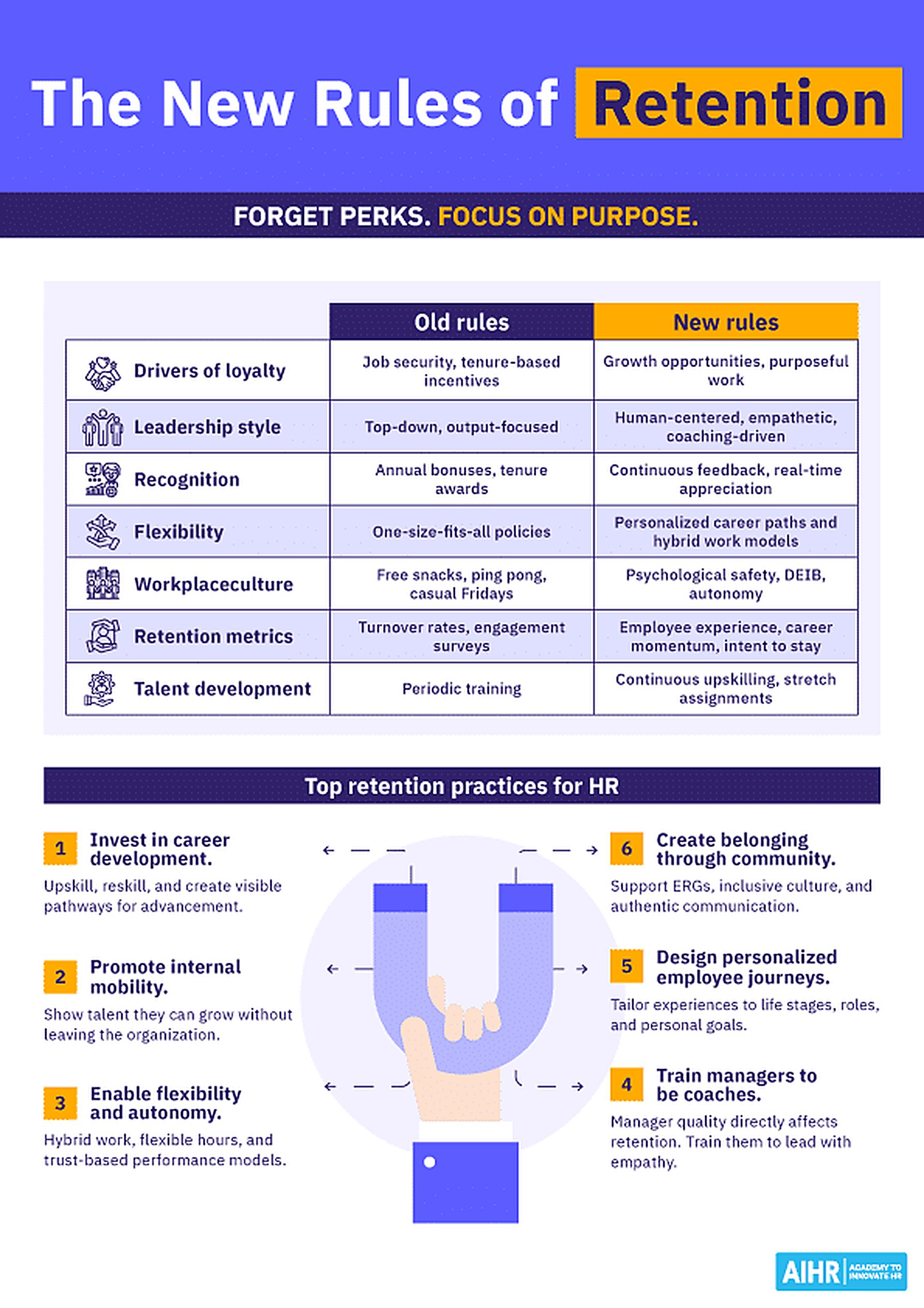
"The good news is, usually people leave for more than one reason. That means an occasional slip up will be forgiven. However, if you break several of these, it will catch up with you" ("14 Reasons"). So, if you have multiple issues, you can't just fix one problem or not make a new habit of that change. Offering verbal praise only occasionally, giving someone a bonus one time, and discussing their career plan but leaving them in the dark for how to get there won't be enough to keep them. It's like a relationship that requires steady communication and effort to maintain - because it is one. It may not be a marriage, but an employee and employer relationship is important for both individual health and business health. "Retention is the outcome you're after (i.e., the share of people who stay with you across a given period), while the strategies are how you reach it. A single perk, such as a one-off bonus, rarely shifts the numbers on its own. Lasting results come from a connected set of practices that address the real reasons someone chooses to build a career with you or move on" (Jay). And what worked for retaining employees 20 years ago is not going to keep them in 2026. I like the Academy to Innovate HR (or AIHR)'s infographic displaying how retention drivers have changed shown below, but even this may need to be updated in a year from now. Gathering constant feedback from employees and staying up to date on what competitors are offering will be the advantage. Employee expectations are constantly changing, and businesses need to adjust to retain (and attract) the best workers.
Otherwise, someone else will.
References
"14 Reasons Why Great Employees Quit Your Team." Lighthouse, 22 May 2024, getlighthouse.com/blog/why-great-employees-quit/.
"15 Reasons Why Good Employees Leave (and How to Keep Them) | Indeed.Com." Indeed, www.indeed.com/career-advice/career-development/why-good-employees-leave. Accessed 6 Aug. 2026.
"Employee Retention Playbook: 10 Proven Strategies with Case Studies." Best Practice Institute, bestpracticeinstitute.org/workplace-report/employee-retention-playbook-10-proven-strategies-with-case-studies. Accessed 6 Aug. 2026.
Jay, Shani. "15 Employee Retention Strategies for 2026 to Keep Your Best People." AIHR, 16 July 2026, www.aihr.com/blog/employee-retention-strategies/.
"Reasons Employees Quit: 15 Causes and What to Do." HeartCount, 11 May 2026, heartcount.com/recognition-retention/why-employees-quit/.
"Why Employees Quit and How to Prevent It." Business.com, www.business.com/articles/reasons-employees-quit/. Accessed 6 Aug. 2026.
Frequently asked questions
How much does it cost to replace an employee?
Research from the Society for Human Resource Management puts the cost of replacing an employee at roughly 6–9 months of that person's salary once you account for recruiting, onboarding, and lost productivity. For a long-tenured employee, the lost institutional knowledge often costs more than the hiring process itself.
What is the most common reason good employees quit?
Compensation is the reason employees most often give, but manager quality is usually the bigger driver underneath it. More than half of workers say their boss influenced their decision to leave a job. People rarely quit over one issue — it's typically pay, recognition, and growth all slipping at once.
How do you keep employees when you can't afford to raise pay?
Offset pay with things that cost less than turnover: flexible scheduling, generous PTO, wellness support, meaningful recognition, and a visible career path. Ask your team which benefits matter most rather than guessing, and consider a professional employer organization to access better benefit rates as a smaller employer.
What is a stay interview and how is it different from an exit interview?
A stay interview is a structured conversation with a current employee about what keeps them engaged and what might push them out. An exit interview only tells you why someone already left. Stay interviews are predictive, so they give you time to act while the person is still on the team.
How can managers prevent burnout on their team?
Review workloads regularly, cut or delegate low-value tasks, and automate repetitive admin work so people spend time on work that matters. Encourage real breaks and actual PTO use. Watch for the opposite problem too — an under-challenged employee disengages just as quickly as an overloaded one.
What retention metrics should we be tracking?
Go beyond turnover rate. Track voluntary versus involuntary departures, turnover by manager and by tenure band, regrettable losses, internal mobility rate, and intent-to-stay signals from pulse surveys. Reporting these consistently is what turns retention from an anecdote into something you can manage.